
Thermal drone inspection of solar farms before winter
Find faulty PV modules before winter sets in. Why an autumn thermal drone survey makes sense, what it reveals and how the report is used in the field.
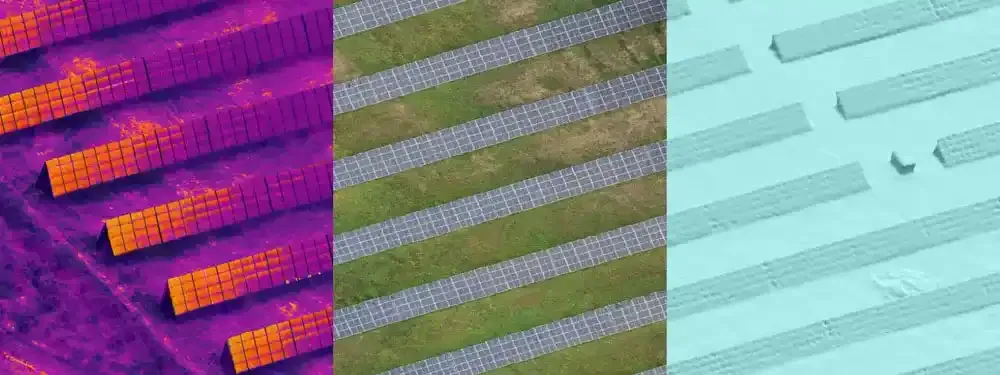
Summer is over and the plant’s most productive months are behind it. Over winter the days get shorter, irradiance drops, and snow and long overcast spells arrive. A fault that goes unnoticed now will often keep costing yield until spring. Autumn is the right time to prepare a solar farm for winter and pin down the maintenance list.
What a thermal camera shows
Most PV faults show up as a temperature difference before they become visible to the eye. These are the findings we see most often in thermal drone surveys:
- Hot spots: A damaged, cracked or shaded cell heats up noticeably more than its neighbours.
- Bypass diode failure: One section of a module appears uniformly hot; that section is not producing.
- Disconnected string: Every module in a string has a different temperature from the neighbouring strings, usually a connector, fuse or cable issue.
- Soiling and shading: Bird droppings, dust, overgrown vegetation or the shadow of a nearby obstacle.
- Junction box and connector heating: Overheating at junction boxes, connectors and on the combiner side.
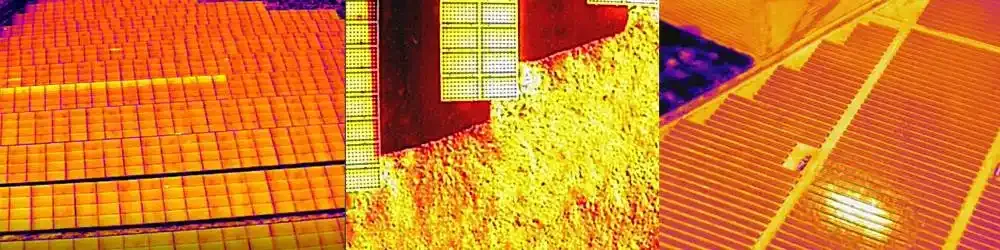
In the thermal image, faulty cells and problem sections of a string stand out clearly from their surroundings.
Why autumn?
For a thermal survey to be meaningful, enough solar irradiance must reach the module surface; if a module carries no current, a fault produces no temperature difference. The international guideline IEC TS 62446-3 recommends at least 600 W/m² in the plane of the array. On clear October days this can still be reached around midday; after November suitable days become increasingly rare.
Cool, clear days with little wind give cleaner images than scorching summer afternoons: the ground is not overheated and reflections are less confusing. In short, autumn is the window in which the survey can still be done but winter losses have not yet begun.
It makes sense for the calendar too. Year-end performance reviews take place now, warranty claims need located and documented findings, and replacement modules can be ordered before winter.
How we work
- Preparation. We obtain the plant layout and module/string numbering and choose the flight day based on irradiance and weather forecasts.
- Flight. Thermal and visual images are captured in the same flight under suitable irradiance.
- Analysis. Hot spots are classified by type and each finding is matched to its row, string and module number.
- Delivery. A thermal orthophoto, a located list of findings and thermal/visual image pairs are reported in order of priority.
From report to field
A report is only as good as the time it takes the maintenance crew to find each fault on site. We share the thermal map and the list of findings through MapSurvey Portal: the crew opens the thermal map on a phone or tablet and locates the module behind each finding on the map. When the same plant is surveyed again the following year, the two surveys are compared side by side to separate repaired, new and growing problems.
How often to survey
- At least once a year, ideally before winter
- At commissioning, before handover
- Before module and equipment warranties expire
- After hail, storms or fire
Let us get your plant ready for winter
If you would like to plan a thermal survey of your ground-mounted or rooftop PV plant, see our thermal drone inspection service or simply get in touch. Because days with suitable irradiance are getting fewer, we recommend planning early.